How Lab‑Grown Pink Diamonds Achieve Vivid, Eye‑Catching Pink Hues
The Core Scientific Mechanism Behind Lab-Grown Pink Diamond Coloration
Vivid pink lab-grown diamonds have redefined the fancy color diamond market in recent years, delivering stable, brilliant, and affordable pink hues that rival rare natural pink diamonds. Unlike natural pink diamonds, which form color through random geological deformation over billions of years, manufactured pink lab diamonds rely on precise, controllable crystal engineering to lock in consistent eye-catching pink tones. Every vivid pink shade visible in finished gemstones stems from targeted structural modifications inside the diamond crystal, rather than external pigment doping. As professional gem producers, we master the full set of technical principles that turn colorless lab-grown diamond rough into premium pink gemstones, with every color-forming step rooted in rigorous crystal physics and material science.
The fundamental structural foundation of lab-grown pink diamond color lies in Vacancies within the diamond crystal lattice. A standard pure diamond consists of a complete three-dimensional carbon atom lattice structure, with each carbon atom tightly bonded to adjacent atoms in an orderly arrangement. When individual carbon atoms are missing from the lattice during diamond growth or post-processing, microscopic empty spaces form, which are defined as vacancies. These structural defects do not compromise diamond hardness or durability but alter the crystal’s light absorption and refraction properties significantly. In colorless lab diamonds, vacancies are sparse and irregular, producing no visible color. For premium pink lab diamonds, we precisely control vacancy density and distribution to create targeted light absorption bands that capture blue and green light wavelengths, leaving pure pink light to reflect and form the iconic pink visual effect.
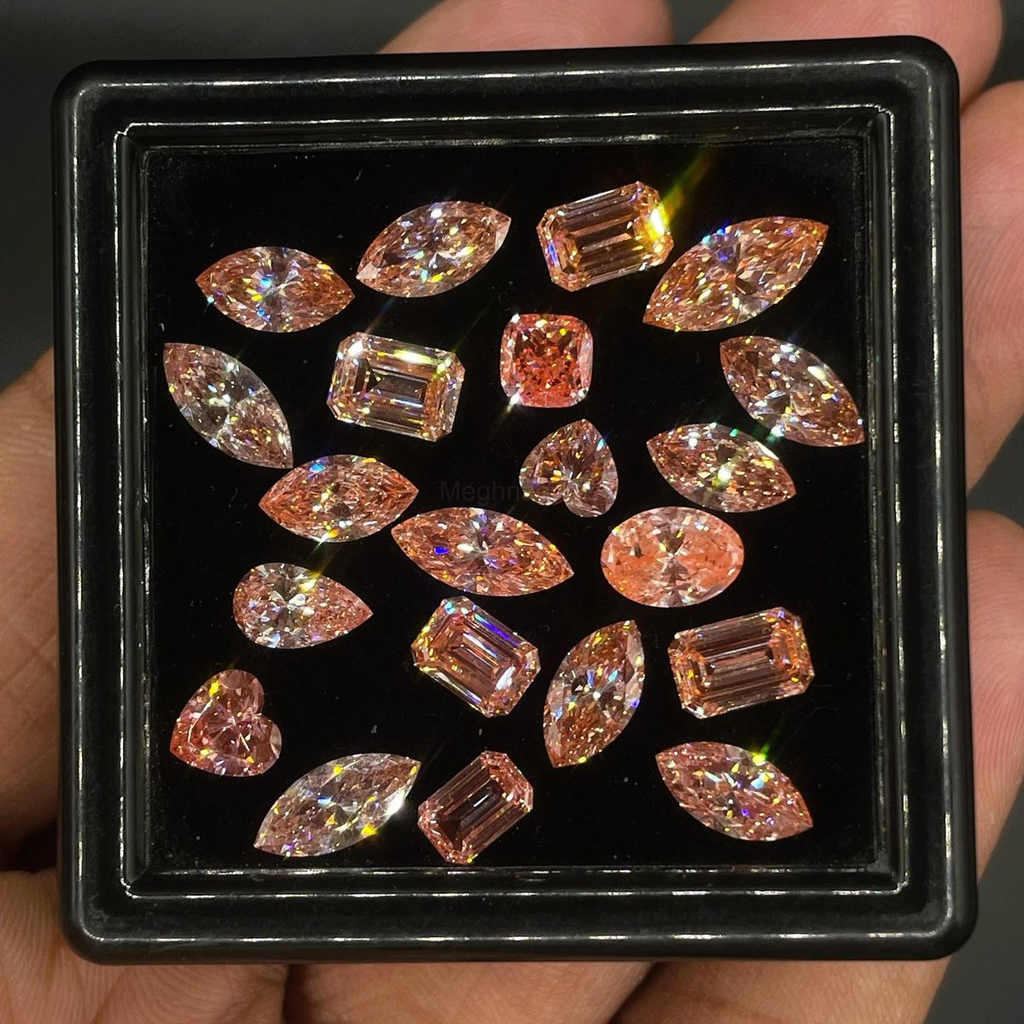
Precise Crystal Structure Adjustment Via Lattice Deformation
Controlled structural changes to the diamond lattice are essential for amplifying pink saturation and vividness, with Lattice Deformation serving as the core technical means for high-grade pink color formation. Natural pink diamonds gain color from accidental lattice deformation caused by extreme crustal pressure and tectonic movement, leading to unstable color distribution and uneven saturation. In industrial manufacturing, we simulate and optimize this natural deformation process with standardized production parameters to avoid random defects and color inconsistencies. Through controlled pressure adjustment during HPHT (High Pressure High Temperature) and CVD (Chemical Vapor Deposition) growth processes, we induce subtle, uniform lattice slippage and micro-deformation inside diamond crystals.
This artificial lattice deformation orderly arranges internal vacancies, eliminating scattered invalid defects and concentrating light-absorbing structures. The refined lattice structure forms a stable 520nm absorption band, which is the key optical feature of vivid pink lab diamonds. Moderate lattice deformation optimizes the symmetry of defect distribution, making the pink hue uniform across the entire diamond facet without color zoning or dull areas. Strict parameter calibration ensures every batch of rough stones maintains consistent deformation levels, laying a reliable structural foundation for mass production of high-saturation pink lab diamonds.
Defect Optimization Through Professional Heat Treatment
Raw lab-grown diamonds with preliminary vacancies and lattice deformation often present dull brown-pink or faint pink tones due to unordered defect structures. Refined color grading and vivid hue enhancement depend entirely on standardized Heat Treatment processes implemented by professional manufacturers. Heat treatment acts as a structural finishing technology that repairs invalid defects, stabilizes effective color-forming structures, and upgrades faint pink color to vivid, eye-catching saturation. We adopt segmented constant-temperature annealing technology, with temperature ranges strictly controlled between 600°C and 1000°C, paired with precise holding time and cooling rate adjustments.
During the low-temperature annealing stage, internal crystal stress generated by lattice deformation is fully released, preventing subsequent color fading or tone deviation. The medium-temperature stage activates vacancy structures and combines them with trace nitrogen impurities in the diamond to form stable color centers. The slow cooling process locks the optimized crystal structure permanently, ensuring the pink hue remains stable for long-term wear and storage. Unlike unregulated casual heating, industrial heat treatment for lab pink diamonds follows unified gemological standards, effectively removing secondary brown and gray undertones that affect color purity and significantly improving the brightness and vividness of pink hues.
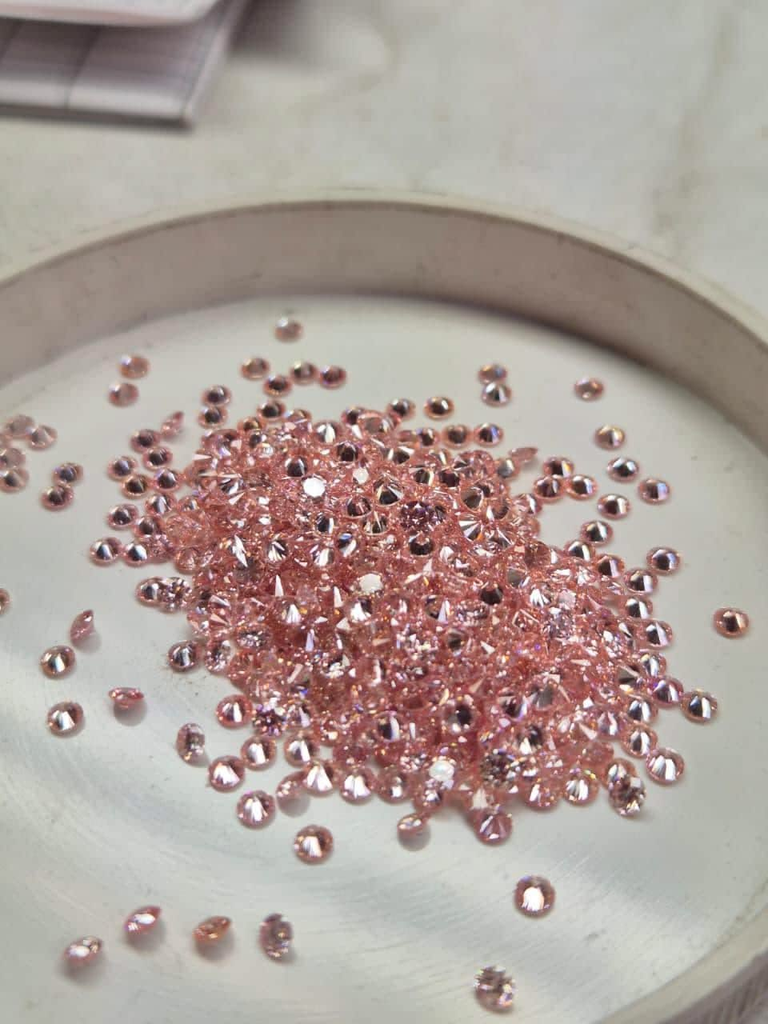
Key Color Center Formation With Nitrogen-Vacancy Systems
The ultimate formation of pure, vivid pink hues in lab-grown diamonds relies on stable Nitrogen-Vacancy (NV) centers, which are the only authoritative color-forming source for commercial high-grade pink lab diamonds. Trace nitrogen impurities are inevitably present in most lab-grown diamonds, and independent nitrogen atoms or single vacancies cannot produce visible pink color. Only when nitrogen atoms accurately bind with adjacent lattice vacancies under optimized heat treatment and deformation conditions can complete NV center structures form. These centers include neutral and negatively charged states, corresponding to 575nm and 637nm zero-phonon line emissions in spectral detection, which jointly form the unique pink light absorption system of lab diamonds.
As experienced producers, we strictly control nitrogen content during diamond growth, maintaining low-concentration nitrogen distribution to avoid excessive nitrogen aggregation that causes yellow or brown discoloration. Through precise process matching, we adjust the proportion of different NV center types to balance pink saturation and brightness. A reasonable NV center density creates a strong, pure pink light response, delivering the vivid, sparkling pink effect favored by the jewelry market. Scientific NV center regulation also enables diverse pink tone customization, ranging from light pink and fancy pink to intense vivid pink, meeting differentiated design and sales demands.
Industrial Advantages of Professional Lab Diamond Pink Factory China
Complete technical systems and mature industrial chains make lab diamond pink factory China the core global supply base for high-quality vivid pink lab-grown diamonds. Chinese professional factories integrate independent crystal growth, structural adjustment, heat treatment, and spectral testing technologies, realizing full-process self-control from raw material preparation to finished gem polishing. Compared with overseas production bases, local factories adopt more flexible parameter tuning mechanisms, able to quickly adjust defect density, lattice deformation degree, and heat treatment schemes according to market demand, stably outputting high-consistency vivid pink diamond products.
Equipped with advanced HPHT and CVD production lines, Chinese factories implement strict batch quality inspection standards. Every pink diamond undergoes professional spectral testing to verify NV center stability, vacancy distribution uniformity, and color tone purity, eliminating inferior products with uneven color or easy fading. Mature industrial supporting systems also reduce production costs while improving color grading accuracy, making high-grade vivid pink lab diamonds more accessible for global jewelry brands and retailers. The standardized and large-scale production model of Chinese factories has filled the market gap of scarce natural pink diamonds, becoming the mainstream supply channel for global fancy pink lab diamond resources.
Market Application and Customization Solutions From Leading Lab-Grown Diamond Ring Companies
Perfect color technology ultimately serves terminal jewelry consumption, and professional lab-grown diamond ring companies connect high-quality vivid pink lab diamonds with global consumer markets through refined design and customized processing. These professional jewelry enterprises cooperate closely with mainstream manufacturing factories, deeply understanding the color characteristics and structural stability of technologically formed pink lab diamonds. They target different consumer groups and design diversified ring styles that highlight the vivid advantages of pink diamonds, from minimalist daily wear styles to luxurious high-end customized engagement rings and anniversary jewelry.
Relying on stable supply from professional factories, lab-grown diamond ring companies can provide standardized pink diamond jewelry with consistent color grades and exclusive customized products with unique pink tones. Professional inlay technology fully preserves the optical performance of vivid pink diamonds, maximizing their light refraction and sparkle effects. Meanwhile, standardized product detection and certification systems ensure every pink diamond ring meets international gem grading standards, with clear origin and color treatment instructions. This mature industrial cooperation model enables vivid eye-catching pink lab diamond jewelry to gain increasing popularity in the global fashion jewelry market, winning recognition from consumers for both beauty and cost performance.
Future Technical Upgrade Trend of Vivid Pink Lab Diamonds
With continuous advancement of crystal manufacturing technology, the color purity, saturation, and stability of lab-grown pink diamonds are constantly improving. Manufacturers are further optimizing lattice deformation precision and heat treatment curves to achieve more accurate NV center control, developing ultra-vivid pink and pink-red high-grade gem products. Intelligent production equipment realizes real-time monitoring of vacancy distribution and defect structure during the growth process, fundamentally improving batch product consistency. In the future, customized pink tones with higher saturation and unique color gradients will become the new development direction of fancy color lab diamonds.
Supported by China’s complete lab diamond industrial chain, the cooperation between factories and terminal jewelry brands will continue to deepen. More innovative pink diamond jewelry designs will enter the market, allowing more consumers to enjoy the rare beauty of vivid pink diamonds at affordable prices. The mature technological system centered on vacancy regulation, lattice deformation, heat treatment, and NV center optimization will always be the core technical support for the sustainable development of the pink lab diamond industry.
Leave a Reply